


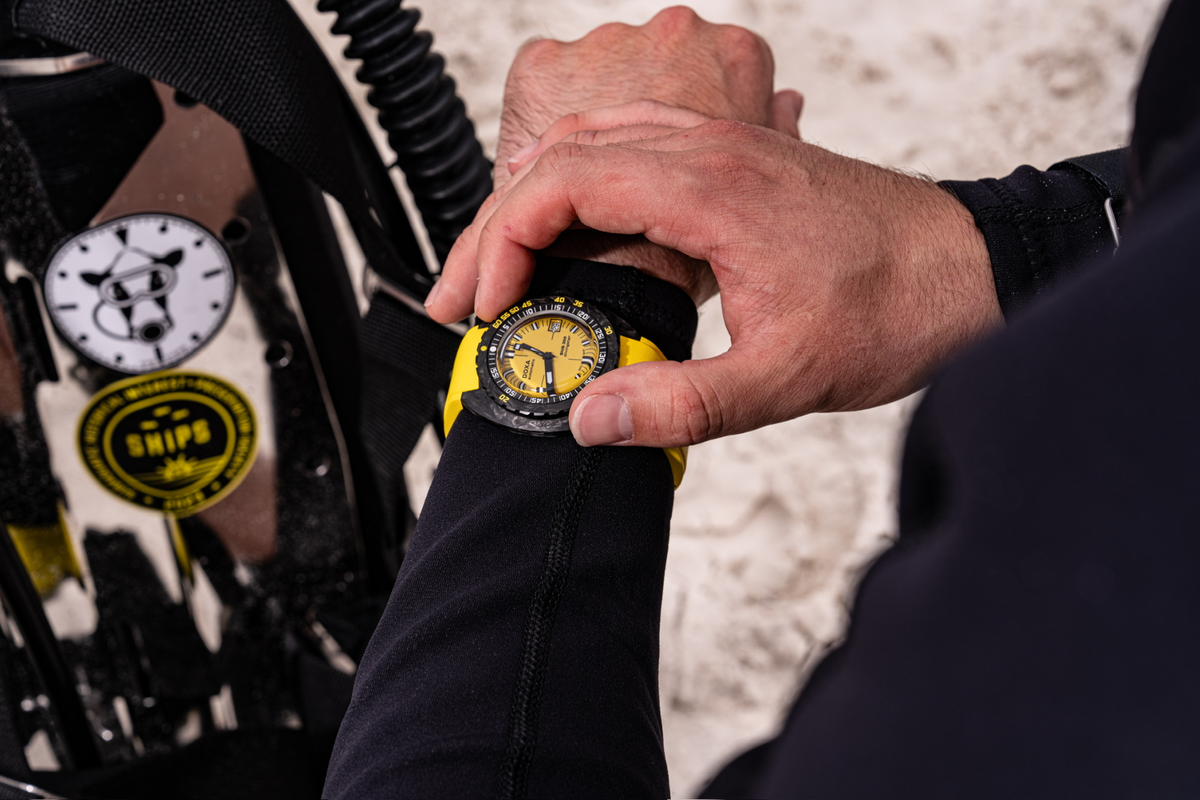
Into the deep with DOXA and the SHIPS Crew
Five-to-six-foot swells, darkening skies and a storm gathering over the Gulf of Mexico. This wasn't quite the Florida sunshine the SHIPS Crew had ordered, but then the best adventures rarely stick to the itinerary…

Geoff Gerrits @watchcowsdive
At the tail end of summer, during August 2026, a group of divers, photographers, journalists and underwater enthusiasts gathered in Panama City Beach, Florida, for a very particular kind of DOXA experience. Brought together by Fort Worth retailer The Watch Preserve, with support from DOXA, Deep Six Expedition Gear and Panama City Diving, the idea was simple: take a community united by a passion for DOXA, diving and underwater history, and get them out from behind their screens and into the water together.
Collectively, they are part of SHIPS, the Subaquatic Historical Interest and Preservation Society. At its heart is a group of like-minded enthusiasts fascinated by the history, equipment and culture of diving, with a shared love of DOXA providing another common thread.

Geoff Gerrits @watchcowsdive
Where diving history runs deep
Florida's Gulf Coast has played an important role in the development of American diving, with Panama City closely associated with the U.S. Navy's pioneering work in experimental diving, saturation diving and the famous SEALAB programme.

Brock Stevens @deepsea.edc
DOXA's own professional dive watches emerged during this extraordinary period of underwater experimentation. When the SUB 300 appeared in 1967, features including its highly visible orange dial and patented no-decompression bezel established DOXA as a serious maker of purpose-built dive watches. Through Jacques-Yves Cousteau and U.S. Divers, the brand became closely associated with the rapidly expanding world of recreational and professional diving. More than half a century later, there was something special about taking DOXA watches back into waters connected with that pioneering era.
From collector to diver
One member of the SHIPS Crew, however, had some work to do before he could join everyone beneath the surface…
Steve Thomas, from Houston, had won his place through a competition organised by The Watch Preserve for its DOXA customers. Michael Pandolfo, Director of Sales & Partnerships at The Watch Preserve, had first met Steve at a RedBar Houston event, where Steve bought a DOXA. When the opportunity later arose to join the Florida adventure, Steve entered and ultimately secured the coveted place.
There was one significant complication, however. Steve wasn't a diver. Rather than leaving him on the boat though, he travelled to Florida two days ahead of the main group and began working with Landon Lassiter of Deep Six Expedition Gear towards his Open Water certification.

Jacob Van Buren @sea_vue
Florida initially played along beautifully. Blue skies and glass-like water greeted Steve as he began his training, with a DOXA SUB 200T Aquamarine Sunray on his wrist. By the time the rest of the SHIPS Crew arrived on August 27, his transformation from collector to diver was well under way. Almost on cue, however, the weather changed.
Stage I and a rough ride offshore
The following morning, an eight-hour charter with Panama City Diving headed offshore towards Stage I and the Hornblower tug wreck. Seas were running swells at around five to six feet, making the hour-long journey significantly livelier than anyone had expected.
Their first destination was Stage I, an offshore structure connected with the U.S. Navy's experimental diving work in Panama City. Its substantial steel remains now sit in around 100 feet of water, transformed over the years into an artificial reef. Beneath the surface, marine life had reclaimed the industrial remnants. Huge schools of baitfish moved around the steel structures while large grouper cruised through the site. Getting back onto the boat in five-to-six-foot swells was considerably less serene, but perhaps equally memorable.

Geoff Gerrits @watchcowsdive
The second dive took the group to the Hornblower, a tugboat deliberately sunk as an artificial reef. Despite the unsettled surface, visibility below was good, allowing plenty of opportunity for exploration and underwater photography.
The original plan was to return to dock, reload the tanks and head back out for shallower afternoon dives. On the journey back, however, the weather radar showed a substantial bank of storms following them towards the coast. The second half of the day was cancelled, a reminder that however carefully a dive trip is planned, the sea ultimately dictates the schedule.

Geoff Gerrits @watchcowsdive
Two crews and two very different dives
On August 29, the SHIPS Crew divided forces. Seven divers headed offshore to explore the Black Bart and Black Pearl artificial reefs, while Michael and several others stayed closer to shore for a very different experience at the jetties of St. Andrews State Park.

Geoff Gerrits @watchcowsdive
For Steve, the charter dives marked the culmination of an extraordinary few days. It was on the Black Bart and Black Pearl that he completed his Open Water certification. He had arrived in Florida as the lucky DOXA collector invited on a dive trip and would leave as a diver, able to participate properly in the underwater world that had fascinated the community around him.
At St. Andrews, meanwhile, the previous day's storms had left their mark. The rock jetties are among Panama City Beach's best-known shore-diving spots, and the group timed its dives around slack water, when the tidal current is at its weakest. Visibility was poor and moon jellyfish drifted through the water, which made photography challenging. Even so, the cameras went below the surface, and the crew came back with some excellent images.

Geoff Gerrits @watchcowsdive
There was a historical element too. Members of SHIPS share an enthusiasm not simply for dive watches, but for the equipment and techniques that shaped underwater exploration. Historic diving equipment appeared alongside modern gear, reflecting a trip that continually moved between diving's past and present. The approach was straightforward: get the equipment wet, use it as intended and enjoy whatever conditions the Gulf happened to offer.
Continuing the story ashore
That afternoon, the focus shifted from experiencing diving history underwater to preserving it on dry land. The SHIPS Crew visited the Man in the Sea Museum in Panama City Beach, where they received a personal tour and interview with museum director Steve Mulholland, a retired U.S. Navy Master Diver.
The museum preserves decades of diving equipment and technology, including SEALAB I and the Beaver Mark IV submersible. For a group fascinated by the evolution of underwater exploration, it provided a natural continuation of everything they had experienced over the previous two days.

Kelly Murphy @beer_nye
The Beaver also held a personal connection for Michael Pandolfo. Michael owns a DOXA previously belonging to Joe Thompson, a pilot associated with the Beaver Mark IV, together with a period Beaver submersible patch. Bringing them to the museum created one of those wonderfully circular moments collectors hope to experience, reconnecting an object with the machine and history of which it had once been a part.
Thompson's story also crossed paths with Jacques Cousteau during the extraordinary period of underwater exploration in the late 1960s, adding another connection between DOXA, the pioneers who wore its watches and the technology changing what humans could achieve beneath the surface.
A community beyond the screen
The team had deliberately left August 30 open as a buffer day, allowing time for interviews, additional photography and potentially another shore dive before everyone departed the following morning. By then, however, the most important result of the trip had little to do with how many dives had been completed or photographs captured.
For all the attendees, the experience reinforced something increasingly relevant in a world supposedly more connected than ever: people still want to belong to something. Social media has made it extraordinarily easy for enthusiasts to find one another, particularly within niche collecting communities. Forums, Instagram and group chats can connect people thousands of miles apart, but digital interaction can only go so far.

Jacob Van Buren @sea_vue
There is a considerable difference between liking someone's photograph of a DOXA and sitting beside them on a pitching dive boat in the Gulf of Mexico. Discussing historic diving equipment online is one thing; descending together onto a site connected with that history is quite another.
The SHIPS Crew brought those worlds together. This relatively small group travelled together, learned from one another, battled rough seas and poor visibility, explored wrecks and jetties and spent time with the artefacts and stories of the people who helped shape modern diving. Online acquaintances became real-world friends, while one collector who arrived because he'd won a competition left Florida with his Open Water certification.
Perhaps that is where the real significance of the trip lies. A watch can provide the introduction, the shared enthusiasm and the excuse to begin a conversation, but what happens next is about people and experiences.

